Showing posts with label Mammals. Show all posts

Sunday, June 28, 2020

Pygmy Hog

                                     Pygmy Hog
                                 (Porcula salvania)

The pygmy hog is a suid (boar or hog) which lives in the foothills of the Himalayas. They are the smallest member of the Suid (hog) family. Today, their only know population lives in Assam, India.


Conservation status: Critically Endangered 

Scientific classification:-
Kingdom:    Animalia
Phylum:      Chordata
Class:        Mammalia
Order:        Artidactyla
Family:      Suidae
Genus:      Porcula
Species:   P. salvania 

They are about 55-71 cm (21.5 to 28 in) long and stand at 20 to 30 cm (8 to 12 in), with a tail of 1 inch. They weight 6.6 to 11.8 kg. Their skin is dark brownish-black and hair is dark. They lives for about 8 years. That feed on roots, tubers, insects, rodents and small reptiles.

Their population is estimated around 200- 250 individuals. Thier only population lives in the Manas National Park. They were reintroduced in the Manas National Park, with 6 individuals and their population have grown upto 200 individuals.

Monday, June 22, 2020

Lion-tailed Macaque

Lion-tailed Macaque
(Maca silenus)

The lion-tailed macaque is an Old World monkey which is endemic to the Western Ghats of India.

Conservation status: Endangered
Scientific classification:
Kingdom: Animalia
Phylum: Chordata
Class: Mammalia
Order: Primates
Suborder: Haplorhini
Infraorder: Simiiformes
Family: Cercopothecidae
Genus: Macaca
Species: M. silenus

The hair of the lion-tailed macaque is black. It's characteristic is the silver-white name which surrounds the head from the cheeks down to its chin, which gives this monkey it's German name Bartaffe means "beard ape". The face is black in colour. Its length is 42 to 61 cm and weight is 2 to 10 kg. Tail is medium in length at about 25 cm, and has a black tuft at the end that is similar to a lion's tail. The life expectancy in the wild is approximately 20 years, while in captivity is up to 30 years.

The lion-tailed macaque is a rainforest dweller, it is diurnal, and is active exclusively during daylight hours. It is a good climber and spends a majority of its life in the upper canopy of tropical evergreen forest. A group usually consists of 10to 20 members.

Lion-tailed macaque feeds on a large variety of fruits, leaves, buds, insects, small vertebraes and birds eggs.

 
The lion-tailed macaque ranks among the rastest and most threatened primates. In the late 20th century, it was on the list of 'The World's 25 Most Endangered Primates'. After conservation programs in Silent Valley National Park, Neyyar Wildlife Sanctuary, Periyar Tiger Reserve and in other protected areas, the population of the species has risen.
At current time, they have a population of 3000- 3500 individuals.

Wednesday, May 13, 2020

The 5 Big Cats of Felidae Family in India

The 5 Big Cats of Felidae Family in India 

The wild forests of India is the home of five species of felidae. Five cats of felidae family are Asiatic Lion, Bengal Tiger, Indian Leopard, Snow Leopard and Clouded Leopard. A new species of big cat know as Pogeyan grey cat also exists which is found in the Western Ghats, but no images or information is available so far.


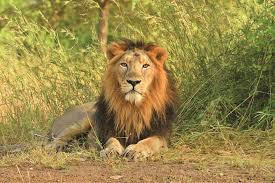
Asiatic Lions 
   (Panthera leo leo)

 They are the big cats found in the Gir forest National Park of Gujarat. They are endangered because of its small population size and area of occupancy. There are about 650 individuals found in India.
                               _____________________


Bengal Tiger 
    (Panthera tigeris tigeris)


 It is the national animal of India. It is widely distributed in the Indian Subcontinent and has classified as endangered with an estimate of about 3,100+ individuals. The Bengal tiger is the largest cat from the family of felidae cats of India.
                                   ________________
   
Indian Leopard
   (Panthera pardus fusca)

It is a leopard subspecies which is widely distributed in the Indian Subcontinent. It is listed as Vulnerable on tge IUCN Red List. There are approx 12,000- 14,000 individuals found in the nation.
                                       ______________


Snow Leopard 
   (Panthera uncia)


It is the leopard species which lives in the high altitudes snow mountain range of the Himalayas. It is listed as Vulnerable with a population of 2,500 individuals found in India.
                                  ____________________


Clouded Leopard 
   (Neofelis nebulosa)

The Clouded leopard is a medium-sized wild cat which lives in the Himalayan foothills. They are the smallest of all the five big cats found in India. They are listed as Vulnerable with a  population of 1000 adults in India.
                                      _______________


Leopard & Tigers  both of them co-exist in the same habitat.

Saturday, May 2, 2020

Golden Langur

 Golden Langur 
(Trachypithecus geei)
The golden langur is an Old World monkey found in a small region of western Assam, India and in the foothills of the Black Mountains of Bhutan. It is one of the most endangered primates species of India.
Binomial name: Trachypithecus geei

Conservation status: Endangered 
Kingdom: Animalia
Phylum: Chordata
Class: Mammalia
Order: Primate
Suborder: Haplorhini
Infraorder: Simiiformes
Family: Cercopithecidae
Subfamily: Colobinae
Genus: Trachypithecus 
Species: geei
The coat of adult golden langur changes from cream to golden during monsoon. The golden langur has a black face and a very long tail measuring up to 50 cm (19 in) in length.
Their diet is herbivorous, consisting of ripe and unripe fruits, mature and young leaves, seeds,  buds and flowers. 
In generally, they lives in troops of around 8 individuals.
The golden langur is endangered with the population trend as decreasing. Their population in India is about 1500 individuals and 2439 individuals in Bhutan as of 2019.